


Ashley Blumhagen was part of an unusual hiking group this past summer. The 41-year-old mother of three works for an outdoor gear apparel company and is the president of the Moose Mountain Bike Trail Society. The volunteer group looks after a network of more than 100 kilometres of trails on two mountains about a 45-minute drive west of Calgary. Blumhagen, another trail society volunteer, a forester and someone from the Alberta government went on four expeditions together to survey the network of pathways on Moose Mountain.
Doug Horner had research and production assistance from Advanced Reporting students:
Valeria Babin, Mia Bare, Jasleen Bhangu, Alyssa Hassett, Ace Jakeman, Scott Rowan, Jayden Steidl, Alejandro Velasco, Charlotte Vos and Olivia Whissell
This story is part of our Active Calgary series on sports and active living in our city.
They were trying to figure out the best way for West Fraser Cochrane, the local branch of an international wood products company, to remove several hundred hectares of forest while doing the least amount of damage to one of the most popular, multi-use trail systems in the province. It was a tall order, but Blumhagen told me that they made real progress. One pathway, for example, went from having about a third of its trees removed to nobody having to ride through any clearcuts at all.
The consultation process was cordial and productive, but Blumhagen described a peculiar dynamic in the group. They would each look at the same trees, but see something completely different. The harvesters saw them in terms of dimensional lumber. “They hardly ever use the word tree even; they just call them merch,” she said. The bureaucrat saw the trees as a potential source of conflict and controversy. And then there were the two mountain bikers: “These are trees and we love them and we want them all,” Blumhagen said.

These opposing visions of the meaning of the trees on Moose Mountain collided in early May at a conference centre in Cochrane. Somewhere around 800 people (I heard varying reports) showed up to face off against the logging company over their plans to harvest wood from the trail network at Moose and another nearby recreation area called West Bragg Creek. An advocacy group, Guardians of Recreational Opportunities in Wilderness (GROW), had rallied their supporters to attend and voice their concerns about how the proposed harvests, which are scheduled for the fall of 2026, would affect the trails.
Alberta has 38 million hectares of provincially owned forest. The government grants companies the right to harvest wood on public land with 20-year-long contracts called forest management agreements. The arrangement comes with a range of responsibilities, including environmental assessments and a duty to consult the public and First Nations who have treaty rights to access their traditional territories. The open house at the conference centre in Cochrane was part of West Fraser’s public engagement process.
The two trail systems are part of Kananaskis Country, a kinda-sorta protected landscape that covers 4,200 sq. km. in the foothills and front ranges of the Rockies in southwest Alberta. About 60 per cent of the region is comprised of provincial parks and one ecological reserve. The other 40 per cent is made up of public land-use zones, a designation that restricts some types of development and activity, but gives the greenlight to industry, recreation, tourism and livestock grazing.
GROW’s logic, as outlined on their website, is simple. West Fraser Cochrane has the right to log on 475,000 hectares of public land. The planned harvests on Moose and West Bragg Creek, as presented back in May of 2024, total 738 hectares, or just 0.15 per cent of the area of the company has access to in Alberta. Given the popularity of these trail networks, and their associated economic value, why not find another place for the company to log?
West Bragg Creek and Moose Mountain, which includes another set of trails on a neighbouring mountain, are linked together and provide complementary experiences on roughly 300 kilometres of expertly built pathways. Moose offers steeper, more challenging terrain geared towards downhill mountain biking. West Bragg, the larger network, is a year-round destination for bikers, runners, hikers, horseback riders, cross-country skiers and snowshoers. The proximity to Calgary offers 1.5 million claustrophobic city dwellers with a quick escape to an iconic mountain landscape.
Want a shorter version?
It’s tricky to get an exact read on the number of people using the trail networks. The 2023/2024 annual report from the Bragg Creek Trails Association, or BCT, provided an estimate based on traffic counters monitoring the highways to the three parking lots and staging areas for their trails. More than 260,000 people visited West Bragg in 2023, a 483 per cent increase since 2009. BCT is a charity with a 146 active volunteers. The group has raised more than $7 million since 2011 and put in 95,000 volunteer hours into building and maintaining the trail network. The president of the trail society for Moose Mountain told me that they had 1,900 members in 2024, up from 750 in 2019. Official members of the non-profit represent a fraction of the people using the pathways. The society also collects data on trail usage from GPS-enabled fitness applications, such as Strava, which show tens of thousands of laps each year.
GROW started an online petition that has collected the signatures of close to 20,000 people who agree that the trees in these two recreational areas are more valuable left in the ground. And the next evening after the open house in Cochrane in May, the group led a protest march at Moose. Hundreds hiked and rode their bikes up the steep gravel road. Many carried hand drawn signs with messages like “Save our Trees!” or “Hands off our trees!”
Something happens when you return again and again, whether alone or among friends, to the same beaten path in the woods. The place and the activity coalesce into an emotional bond. Take Race of Spades, for example. The trail descends 400 metres over four kilometres and includes a dozen or so log-hewn features, such as narrow boardwalks and stomach-flipping drops. It’s one of the oldest tracks on the mountain. It predates the trail society at Moose, which formed in 2008, and was built in secret, likely sometime in the late 90s, under the cover of all those spindly lodge-pole pines. And it’s Blumhagen’s all-time favourite. “It goes through a lot of really neat terrain and a bunch of different zones, in terms of the character of the terrain and the forest,” she said. “I have a very sentimental attachment to it.”

Blumhagen started mountain biking in 2018, becoming the president of the Moose Mountain Trail Society just two years later. She is a self-described cautious rider, and Race of Spades was one of the first challenges she set for herself. It’s been a touchstone ever since, a way to measure her development as a rider. And so the trees that line that trail have become companions to her growth in a new sport and her connection to a new community. “Moose Mountain I think is a really special place, being so close to town, so accessible, but you feel like you’re far away and away from the city and really out in nature,” she said. “I think there is a huge misunderstanding in the value there.”
Blumhagen is not alone in her confusion about the way outdoor recreation assets are being valued in the province. A 2021 report by the Tourist Industry Association of Alberta, a non-profit group that advocates on behalf of the sector, calculated that Albertans spend $2.3 billion on crown land outdoor recreation trips every year. And another $376 million on the equipment they need to go on those trips. Darren Reeder, the executive director of TIAA, explained in an email that they commissioned the report because they had noticed how other jurisdictions, places like British Columbia and Colorado, were taking a more deliberate approach to developing outdoor recreation economies. Reeder described how BC set out 20 years ago to become a global leader in the realm of outdoor recreation and now Albertans are leaving home to spend $1.2 billion in the neighbouring province every year.
Outdoor adventures have entered a new era of popularity worldwide. More people are becoming health conscious and gravitating towards nature-based sports to reduce stress and improve their health. Social media inspires people to seek out the remarkable vistas they see posted to their feeds. Better equipment, like pedal-assist e-bikes, and new technologies, like GPS-enabled map applications for smart phones, has made the wilderness more accessible than ever. Christian Bagg, founder of a bike and wheelchair technology company in Calgary, won a Governor General’s Innovation Award this year. He invented the Bowhead Reach, a new type of rugged off-road trike that empowers people with a range of abilities to explore the outdoors independently.

An increasing number of people are travelling abroad to have new kinds of experiences in the outdoors. People pick up and move to find new homes with access to their favourite nature-based activities. The possibility of remote work has allowed people to choose where they live based on lifestyle instead of job prospects.
Alberta has the raw materials, the building blocks, for a world-class outdoor recreation sector, but it will take a shift in perspective to realize the potential. The report by the tourist industry association identifies Crown land, which makes up 60 per cent of Alberta, as the backbone for the recreation economy. These lands, however, have prioritized other industries like oil and gas, forestry, ranching and mining. Recreation has been treated as a nice-to-have activity, something to be fit in behind the real priorities. “Such a management philosophy has created a reactive approach to crown land outdoor recreation and an underrealized outdoor recreation economy,” the report concludes. Reeder pointed to a new provincial plan to encourage the development of all-season resorts on Crown land as evidence that the Alberta government has identified outdoor recreation as a way to boost tourism and diversify the economy.
No one disputes that West Fraser Cochrane, a subsidiary of West Fraser Timber (a company with more than 60 facilities worldwide), has the right to harvest in Kananaskis Country. They recently bought Spray Lakes Sawmills, a local and family-run business that had operated the mill in Cochrane for 80 years. The acquisition included the forest management agreements that Spray Lakes had signed with the Alberta government. The long-term contracts grant West Fraser access to the timber on crown land all along the front range of the Rockies in an area known as the Eastern Slopes.
The original vision for Kananaskis Country, as outlined in the policy that created the region in 1977, reflects deeply held, but sometimes contradictory, Albertan values: the right to explore and enjoy our beautiful natural heritage while at the same time respecting the need for industry and the dignity of a hard-earned living. The effort to balance these priorities, and the fact that Kananaskis includes the headwaters for the Elbow and Bow rivers, is how we ended up with such a patchwork of provincial parks, ecological reserves, recreation areas and public land-use zones.
Alf Skrastins, the vice-president of the Bragg Creek Trails Association, told me that it was this multiple-use approach to large parts of Kananaskis that allowed these path systems to develop in the first place. He started skiing in the West Bragg area in the 1970s and joined the trail society in 2009, not long after he retired. Skrastins founded the University of Calgary’s Outdoor Centre in 1978 and worked for several years as an editor for Explore Magazine. He described how the government agency that oversees protected areas, which as of 2023 is called Alberta Forestry and Parks, has never seemed all that interested in building trails. Few new ones have been built in any of the provincial parks in Kananaskis since the area was created. Skrastins estimated that official trails in the region were outnumbered by unauthorized trails by roughly three to one.


Public land use zones have fewer restrictions than parks, which allowed the different trail networks to evolve in unique ways. “I think in the long term that vision has proven to be extremely wise in that it has allowed areas to develop their own character throughout Kananaskis Country based on local interests,” Skrastins said.
One trail at West Bragg, Telephone Loop, was cut through the forest in 1913 to run a telephone landline between the Elbow ranger station and the Jumping Pound ranger station. Other trails got their start in the 1950s and 60s during an active period for industry when trees were cleared for seismic lines, oil and gas wells, road and pipeline construction. The Moose Mountain road, the one the protesters marched up in early May, was built and is maintained by an oil and gas company. There are 12 active sour gas wells and facilities in the area.
Spray Lakes Sawmills logged parts of West Bragg Creek in 2012 and 2013. The Alberta government had asked the company to carry out the harvest as a way to create fire barriers for the local communities. Interactions between the trail society and the logging company were tense at first, but they eventually found a way to work together. Skrastins described how Spray Lakes helped turn some of their roads into cross-country ski trails. One of the company’s operators used a 30-ton excavator to build a long section of Snakes and Ladders. Volunteers had planned to spend two and half months on the new trail, but the operator finished it in a week and a half. “It was basically all done and none of that cost us anything,” Skrastins said.
The Moose Mountain and Bragg Creek trail groups have signed agreements with the provincial government that grants them the authority to build and maintain their trail networks on Crown land. The contracts clearly outline how the path networks are part of a multi-use area and that the groups have a responsibility to cooperate with forestry and energy companies, ranchers, and indigenous groups. Mike Duszynski, the executive director of Bragg Creek Trails, told me that he thinks the path system will likely be improved by the logging project. “By collaborating we can change those threats into opportunities and we can work together to help each other,” he said.

Albi Sole, a founding member of the Outdoor Council of Canada and the board chair of the Outdoor Recreation Coalition of Alberta, agrees that the only way forward on public lands is together. “It is a shared landscape and it will always be a shared landscape,” he said. The key is to find a way to collaborate that best serves the public interest. Logging has a rightful place when done responsibly. “It needs to be done in a way that doesn’t tear up the soils, doesn’t damage the streams, doesn’t destroy the recreational value—but it doesn’t actually have that big an impact on the recreational value at the end of the day,” Sole said.
Part of his ambivalence about logging in Kananaskis is philosophical. He thinks we need to let go of our romantic ideal of nature, as something that is pristine and unspoiled—a place beyond or outside of human influence. We live in a world of altered landscapes. It doesn’t help to pretend otherwise, and he said there are more pressing matters at hand. We reached the tipping point, the moment when demand outstripped capacity in the backcountry, 15 years ago. “There’s an awful lot of work to be done and we’re really behind the eight ball,” he said.

The Outdoor Recreation Coalition of Alberta is trying to unify non-motorized recreationalists so they can better advocate for the community to the provincial government. Sole pointed to an area northwest of Calgary called the South Ghost, another public land-use zone, as an example of one of the more serious concerns in the backcountry. There have been reports of people shooting guns next to roadways and
trails, even at explosive targets like propane tanks. Chaotic firearm use has pushed
everyone else out of the area. Sole acknowledged that target shooting is a legitimate
form of recreation, but only when done responsibly and in specific areas. The ministry of
Forestry and Parks implemented a temporary prohibition on firearm use for the area at
the end of August. A lack of enforcement of rules and a deficit of infrastructure, such as trails,
parking lots and washrooms, are some of the key challenges facing the community. “If
we can figure out how to solve some of those problems, then we have the potential to
create here what I would call a world-class outdoor recreation system,” Sole said.
Joey Reinhart is one of the founders of the Guardians of Recreational Opportunities in Wilderness, or GROW, the group that stirred up a coordinated opposition to the proposed harvest at Moose and West Bragg. The digital marketer is 31 years old and has been mountain biking in the foothills west of Calgary for a decade. He acknowledges the long history of the symbiotic relationship between logging companies and trail builders in western Canada. He is also quick to point out the economic value of the forestry industry. “It puts a lot of food on the table for Albertans,” he said.
West Fraser Cochrane released an update to their harvest plan in late October that included a report on the public feedback they had received at the rowdy open house in May as well as what they had learned on the field days with the trail groups. The company reduced the area of the harvest on Moose Mountain and West Bragg Creek, from 738 hectares down to 556 hectares. Their original plan from back in 2021 for the two areas had been for 880 hectares. Everyone that I spoke to from the trail groups, as well as Reinhart, agreed that the company is making a meaningful effort to minimize the impact of the harvest. “They actually did a fairly good job,” Reinhart said about the latest plan. “They have thought about the longevity of the trails.”
But the GROW team is not interested in compromise. They’re trying to get the Alberta government to see the forests that shelter the trail networks in a new light. The original multi-use vision for the eastern parts of Kananaskis didn’t foresee the dramatic ascendance of recreation over the past few years. The balance of power has shifted. “I don’t think anybody ever saw mountain biking or trail use in these areas getting this big, but it’s definitely blown up,” Reinhart said. “It’s just going to continue growing.” The ideal scenario for GROW is a land swap. They’re advocating for the minister of Alberta Forestry and Parks, Todd Loewen, to provide West Fraser with another parcel of forest, one that doesn’t include hundreds of kilometres of trails that have been worried over for years by a small army of volunteers.
West Fraser’s public engagement report outlines how the Alberta government views the areas of West Bragg Creek and Moose Mountain as posing a significant risk for wildfires. “Through fuel removal and reduction, the planned 2026/2027 harvest would help mitigate wildfire risk,” the report reads. But the plan does not include firebreaks and the cutblocks would be reforested. Reinhart and his colleagues with GROW have consulted wildfire experts familiar with the area who said the best way to protect Bragg Creek and Redwood Meadows would be to create firebreaks closer to the communities.
The press secretary for the Ministry of Forestry and Parks suggested that I contact West Fraser when I emailed to set up an interview with Todd Loewen, the minister. The director of communications for West Fraser referred me to their recently released public engagement report, which mentions that the company has discussed a land swap with the government. “Indications to date are that identifying alternate areas available for allocation would be difficult,” the report reads. Reinhart’s next move is to prepare an economic case for leaving the trees in the ground. GROW has a meeting scheduled with Loewen at the end of November.
Before she was elected as the MLA for Banff-Kananaskis in the spring of 2023, Sarah Elmeligi worked as a wildlife biologist who specialized in helping communities find constructive ways to coexist with grizzly bears. She is familiar with the variety of stakeholders with a claim to Kananaskis, but warns that multiple uses does mean infinite uses. Elmeligi is the NDP shadow minister of environment and protected areas and thinks that the government needs to consider the cumulative effects of all the demands being made on the landscape. She has also discussed the issue of logging on Crown land with members of the Blackfoot Confederacy and Stoney Nakoda First Nation who feel they are often not adequately consulted about proposed harvests on Treaty 7 territory. “They’re given very little money to conduct site visits or to go out there and do any assessments of proposed cut block areas to identify traditional or current sites of significance,” she said.
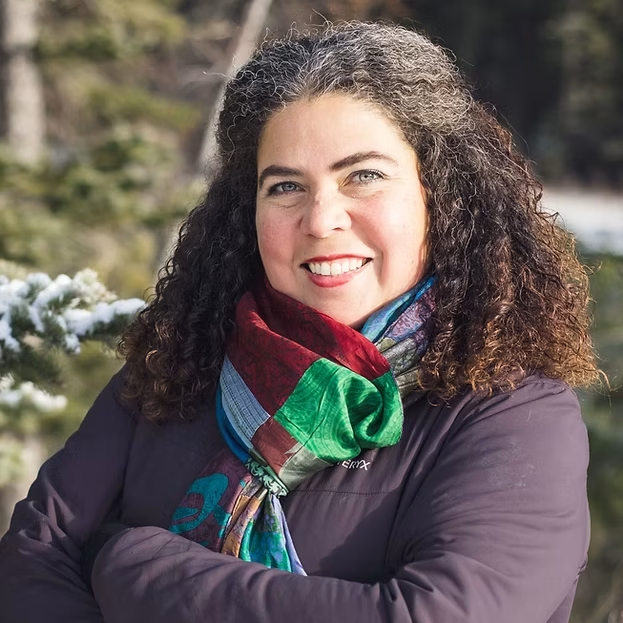
Elmeligi has fielded a lot of complaints from her constituents about the proposed clear cuts at Moose Mountain and West Bragg Creek. “It has created almost like a perfect storm where you have the same trees promised to forestry and to recreation groups,” she said. The first promise was to Spray Lakes Sawmill, now West Fraser, back in 2015 when Alberta Forestry and Parks renewed their management agreement for the area for another 20 years. The second promise, the one to recreationalists, was more tacit. It came in the form of the Kananaskis Conservation Pass ($15/day or $90/year for day-use access), which the government introduced in June, 2021. The new fee was pitched as a way to improve recreation infrastructure and protect the environment after the pandemic inspired record numbers of visits to Kananaskis. There was a 31 per cent jump in the number of annual trips from 4.1 million in 2019 to 5.4 million in 2020. Some Kananaskis goers are angry that the government collected money to fund trail upgrades and conservation efforts only to turn around and allow some of those same trails to be logged.
Elmeligi sees the conflict between hikers and foresters as evidence that the government has avoided making tough decisions about who can do what and where on Crown land. The priority for the landscape on the Eastern Slopes, which runs the length of the Rocky Mountains in Alberta, has always been water quality and quantity. The region includes the headwaters for the Saskatchewan-Nelson Rivers drainage basin, which flows across the prairies and into Hudson’s Bay, and for the Peace-Athabasca River drainage basin, which empties into the Arctic Ocean. Elmeligi connects the poor management of the Eastern Slopes over the past 50 years with the current debate about building more dams in the province. The need for more reservoirs is related to mismanagement of the headwaters. The South Saskatchewan Regional Plan provides guidance on land-use priorities for southern Alberta. It’s a big-picture strategy for managing the landscape in the public interest for the long term. The experts I consulted about land-use planning and cumulative effects, including an ecologist and a retired law professor, agreed that the policy document is good in theory but falls short in practice. It’s all hat and no cattle, to use the preferred Albertan idiom.

The regional plan for southern Alberta clearly articulates watershed protection as the foremost priority for the landscape. It does not, however, provide enough granular detail about how to turn that intention into action. The plan lacks the regulatory teeth required to hold politicians and private companies accountable. “If watershed protection is the highest priority, then it would make sense to have something in there saying that operational decisions in different industries have to be able to prove that they’ll have a neutral or beneficial effect on water security before they can be approved,” said Kevin Van Tighem, an author and conservationist who was an advisor in the initial stages of drafting the land-use plan for the South Saskatchewan watershed.
Mountain bikers, hikers and cross country skiers look at the trees along the trails at Moose Mountain and West Bragg and see a critical aspect of their experience of the outdoors. Foresters look at the same trees and see 2-by-4s. Conservationists see all those lodgepole pines for the role they play in the storage and release of freshwater. Maybe the root cause of these sorts of conflicts is an outdated conception of Alberta as having a limitless expanse of untouched wilderness. Premier Danielle Smith, in her fall throne speech in 2023, said her government was preparing to more than double the population of the province to 10 million by 2050. Tough decisions lie ahead as exponential growth rachets up the pressure on a finite landscape.
I drove out to West Bragg Creek on a Saturday morning in early October to try my hand at trail building. A group of young kids, some clad in one-piece snowsuits, were playing in a field next to the parking lot. An adult in the group told me they were part of an organization called SOGO Adventure Running. The kids were learning about orienteering, how to find their way through the trees using maps.
I found Mike Lajoie, the leader of our volunteer crew, in the garage where the trail society stores their gear and machinery. He had driven in from Okotoks. I also met Sean Clarke, a pilot for WestJet. It was a two kilometre bike ride to get to Snowy Owl, the all-season trail we’d be working on that day. The goal, Lajoie explained, was to complete the last stretch of a new section, so about 40 or 50 metres.
We set to work on the forest floor with garden hoes and something called a mattock, which looks like a pickaxe, but one end has a broad shovel-like blade. It was handy for cutting through roots. We dug up and scrapped away the top soil, exposing the sandy clay beneath. Lajoie explained that trail building was all about managing water, which would flow easily off the clay. A dry trail is less susceptible to damage.

It was a calm, cloudless fall day. People passed every so often, mostly on foot and often with a dog or two. The conversation came easy. I learned that Clarke, who was 57, volunteered for a half dozen organizations, including the Food Bank. He wore a baseball cap that read “War on Cars.” Lajoie, who was 50, worked for a company that made restaurant interiors. We talked about craft beer and our favourite trails to ride or hike. I asked them about the logging project. “I’m 50-50,” Lajoie said. Clarke had a similar take. They loved West Bragg, but felt that the forestry industry was a necessary part of the economy.
An older man in a collared shirt and suspenders walked past us around mid-afternoon. I caught up with him a little ways down the trail to get his thoughts about the plan to log the area. He took off his sunglasses to reveal a set of eyeglasses. Blake Gordon was 86-years-old. He had been the dean of one of the automotive departments at SAIT, but was long since retired. He had walked through some older clearcuts earlier that day, ones that Spray Lake Sawmills had done back in 2012, and thought the hillsides had recovered well. Then he dived into an explanation of how the Rocky Mountains started to form some 80 million years ago. Two tectonic plates, one much larger than the other, had collided for tens of millions of years. “So you’re getting a geology lesson,” he said, smiling.
Talking to Gordon made me think about something Joey Reinhart, one of the founders of GROW, had told me about biking at Moose: “It’s like you bought this bike and all of a sudden you have 60 new best friends.” We let our guard down when we’re out in the woods. It’s so much easier to connect and find common ground than it is back in the city.