


When I met Elena Myasnikova in the foyer of her home, the first thing that stood out was a piece of art on the wall by the stairs.
I didn’t ask her about it immediately, I was preoccupied with introductions and being shown to her home studio. But later, she told me that the piece was made using a technique called paper cut, a very fine process where the artist cuts small pieces out of a sheet of paper to create detailed artworks.


Myasnikova had a few works that used this technique, including a series of three works where the paper is cut to look like trees and another work of a cat.
“I use artisan wallpapers,” Myasnikova said, showing me a book of paper cut works from Asia. “[Artisan wallpapers] are super cool in their finish, you can have so many different kinds of colours and finishes. It’s a very big part of my art.”
The world on fire
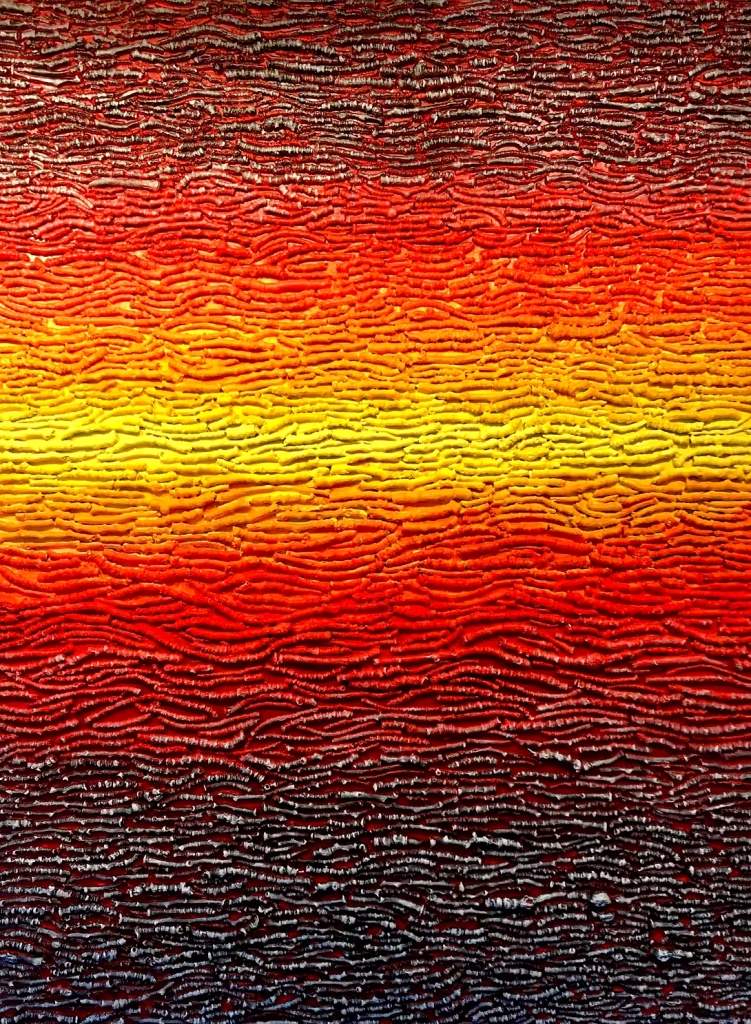
When I first looked at Myasnikova’s work on her website, there was one piece that made a strong impression — a painting with warm colours of red, orange and yellow. Its title is On Fire, and it belongs to a series of three paintings Myasnikova’s called When Earth Calls.
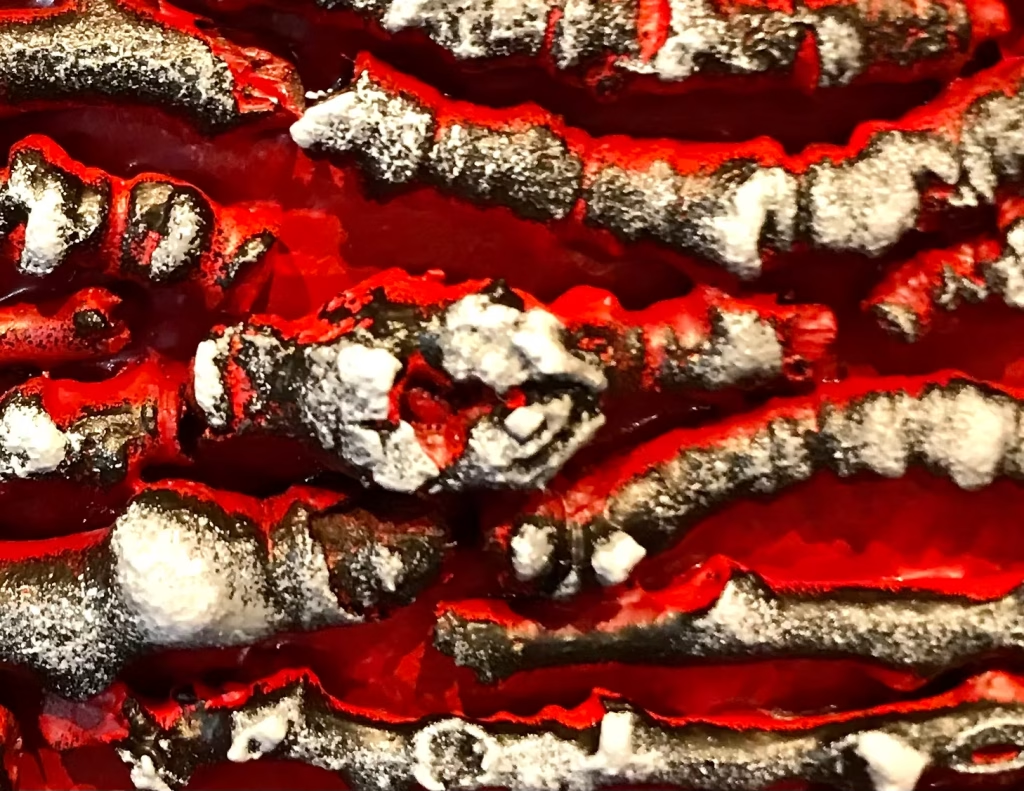
On Fire leaned against a wall in her studio, hidden behind another piece that Myasnikova was still working on at the time. To its left were the other two paintings in the series. When she asked why I wanted to interview her, I said it was because of this specific painting. Myasnikova then moved aside the painting covering the piece, and I got a full view of the fiery colours.
The photo on her website doesn’t do justice to seeing the piece in person. Up close, I saw the details of the work, the way Myasnikova incorporated branches she found in a nearby park. She said to stand further back in her studio and look at it from afar. There, I saw what the piece was meant to represent — our world on fire, and the ashes left behind.
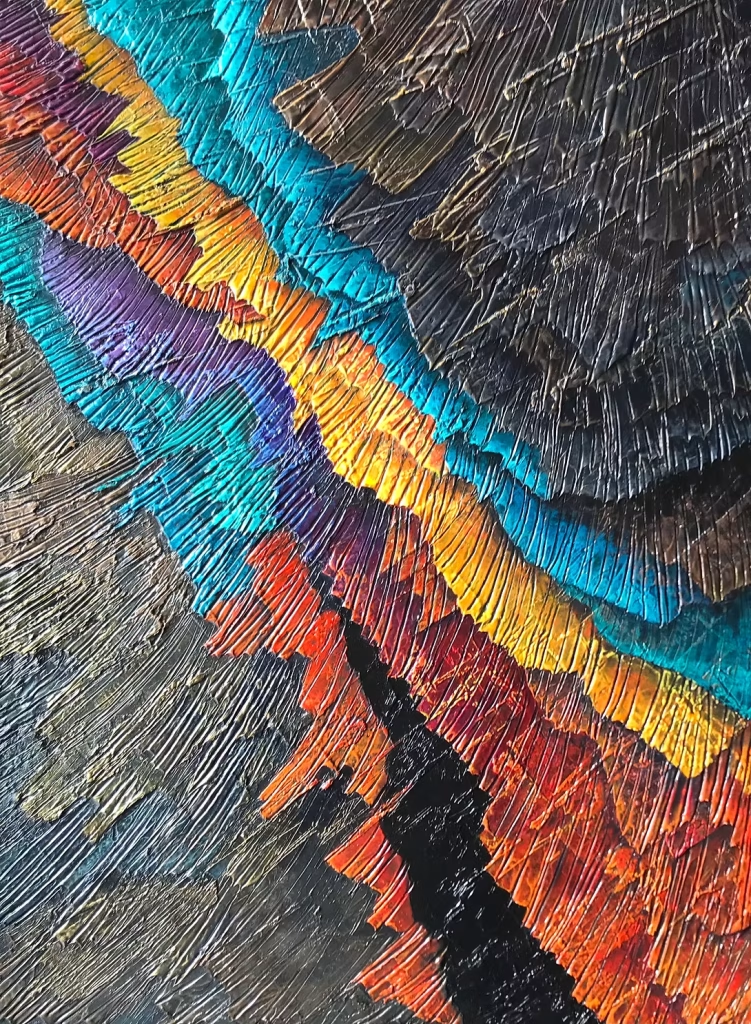
The first piece in the series, titled The Bright Side, Myasnikova described as a “sarcastic take on the bright side.”
At first, I wasn’t sure what The Bright Side was meant to represent — to me, it looked like rays of colourful sunlight bursting through stormy clouds. Myasnikova then told me about the meaning behind the painting.
She explained that The Bright Side shows the layers of soil that archaeologists find when they dig down. Each layer is a different colour – gray, brown and other earthy tones that show periods from our past. But there will be one layer of brightness.
“In millions of years when humans are no longer here, there will be some kind of life forms that will be here,” says Myasnikova. “They will dig layers of soil to study the past from different layers. They will probably come across a very bright line in between very dark soil. [The dark soil] was before and after humans. [The bright line] is plastic, which doesn’t go anywhere.”
Myasnikova said that plastic would be the only bright thing left by humans. Ironically, there is nothing bright or good about that.
She states, “We cannot avoid not to have brightness in our soil layer.”
The second work in the series is titled It’s All In Us — a circle of thinly shaved wood and small pebbles that draws the eye to a red center.
On her website, Myasnikova questions why we started abusing what creates and cares for us. All In Us reflects how we surround ourselves with nature and we “like to think that we are not completely ignorant on this topic.” Still, humans “prefer a life of overproduction, overconsumption, contamination and distraction.”
This brings us back to On Fire, the final work in the series that represents a world defined by climate change and human destruction — burning forests, melting glaciers, species going extinct and rising seas.
“We are on fire,“ Myasnikova wrote on her website about On Fire. “Will we be able to survive past the ashes?“

Myasnikova is a gentle woman with an overflowing passion for art. She is knowledgable about the world around her and was thrilled at the chance to share that with me. Her visual statements urge you to reflect upon the world at large and from a different perspective to understand the messages hidden in the paint.
On the stage
Before Myasnikova came to Canada nearly 25 years ago, she lived in Europe. Her father was Russian and her mother Ukrainian — as a military family, they moved around a lot.
Myasnikova wasn’t much of an artistic child, there was never time for her to focus on studying a subject she had interest in. She only dipped her toes into dance and different types of crafts when and where she could. Growing up during the Soviet era, she lived in several smaller cities along the border with no real opportunity to get professional training.
When Myasnikova was 15, her family moved to Uzbekistan which is home to the Benkov Art Academy located in Tashkent, the largest city in Central Asia with a population of three million. There, she attended the academy where she trained with private art teachers and soon realized that she wanted to explore a future in art.
“I had many different interests, but something that I really wanted to do was to work with my hands,” says Myasnikova.
After finishing her education in art, Myasnikova started working in theatre. In Europe, puppet shows are insanely popular for both children and adults.
At the theatre where she worked, Myasnikova would design puppets, stages and costumes. A portfolio of her work contained designs targeted to a mature audience along with those that were more youthful and child-like.
“It is an unreal feeling,” Myasnikova said as she looked over sketches she created for various performances. “You have so many people working from just an idea… you build it all and then you see it all come alive. It’s magic. When you work with puppets, it’s double magic.”

Sketches from Myasnikova’s time in theatre. PHOTOS: SUPPLIED BY ELENA MYASNIKOVA 
Sketches from Myasnikova’s time in theatre. PHOTOS: SUPPLIED BY ELENA MYASNIKOVA 
Sketches from Myasnikova’s time in theatre. PHOTOS: SUPPLIED BY ELENA MYASNIKOVA 
Sketches from Myasnikova’s time in theatre. PHOTOS: SUPPLIED BY ELENA MYASNIKOVA 
Sketches from Myasnikova’s time in theatre. PHOTOS: SUPPLIED BY ELENA MYASNIKOVA
When Myasnikova moved to Canada she brought along her love for theatre. Unfortunately she didn’t find the same opportunities here because the industry in this country is quite different than it is in Europe.
She settled in Ottawa and worked gig to gig rather than as a permanent designer. She found some success in designing for commercials and helping artists with their projects, but it was not the same as working in European theatre. She worked as a fashion designer for several companies in Toronto and obtained a degree in Fashion Design.
Around 2010 Myasnikova relocated to Calgary and started working as a product developer, buyer and coordinator between vendors and Canadian Tire.
Aspiring artists
In 2020 Myasnikova left her corporate job and returned to art full-time, devoting her career to teaching children between the ages of 6-14 how to make their imaginations come to life on canvas.
Myasnikova presented some of her students’ work to me — one explored paper cutting, another was learning how to draw animals by depicting their family as elephants, and one student, a gymnast, made drawings of gymnasts in dynamic poses with graphite on paper.
Looking help realize their aspirations, one of Myasnikova’s students wants to become an architect when they are older. When that sentiment was expressed, she and the student started focusing on understanding perspective and drawing buildings to help the student prepare. She also recommended various programs for the student to attend to get more information about an education and a career in architecture.
Myasnikova said about her classes: “This is something that I put a lot of my heart into — cultivating those things [future ambitions] in kids.”